

SCIg IS STRONGLY RECOMMENDED BY
a professional CIDP guideline1
guideline summary
2021 EAN/PNS guideline on diagnosis and treatment of CIDP strongly recommends SCIg as an option for CIDP maintenance1
The guideline highlights the importance of:
Treatment flexibility
Consider patients’ personal preferences and clinical benefits when choosing SCIg or IVIg1
- While the guideline does not recommend a preference between IVIg or SCIg for CIDP maintenance, it does support patient preferences
Personalized dosing
Tailor SCIg dose (g) according to individual treatment response1
- Clinical study results indicate that there were lower relapse rates in the higher-dose group. There is insufficient evidence that a higher dose is superior to a lower dose
- Therefore, long-term dosing should be individualized and tailored to find the most appropriate dose
Watch the lead author of the EAN/PNS guideline
Dr. Peter Van den Bergh, on behalf of the task force
- Introduction and Task Force (0:00-0:57)
- CIDP Definition and Diagnosis (0:58-9:33)
- Induction Treatment Recommendations (9:34-10:40)
- Maintenance Treatment Recommendations (10:41-12:25)

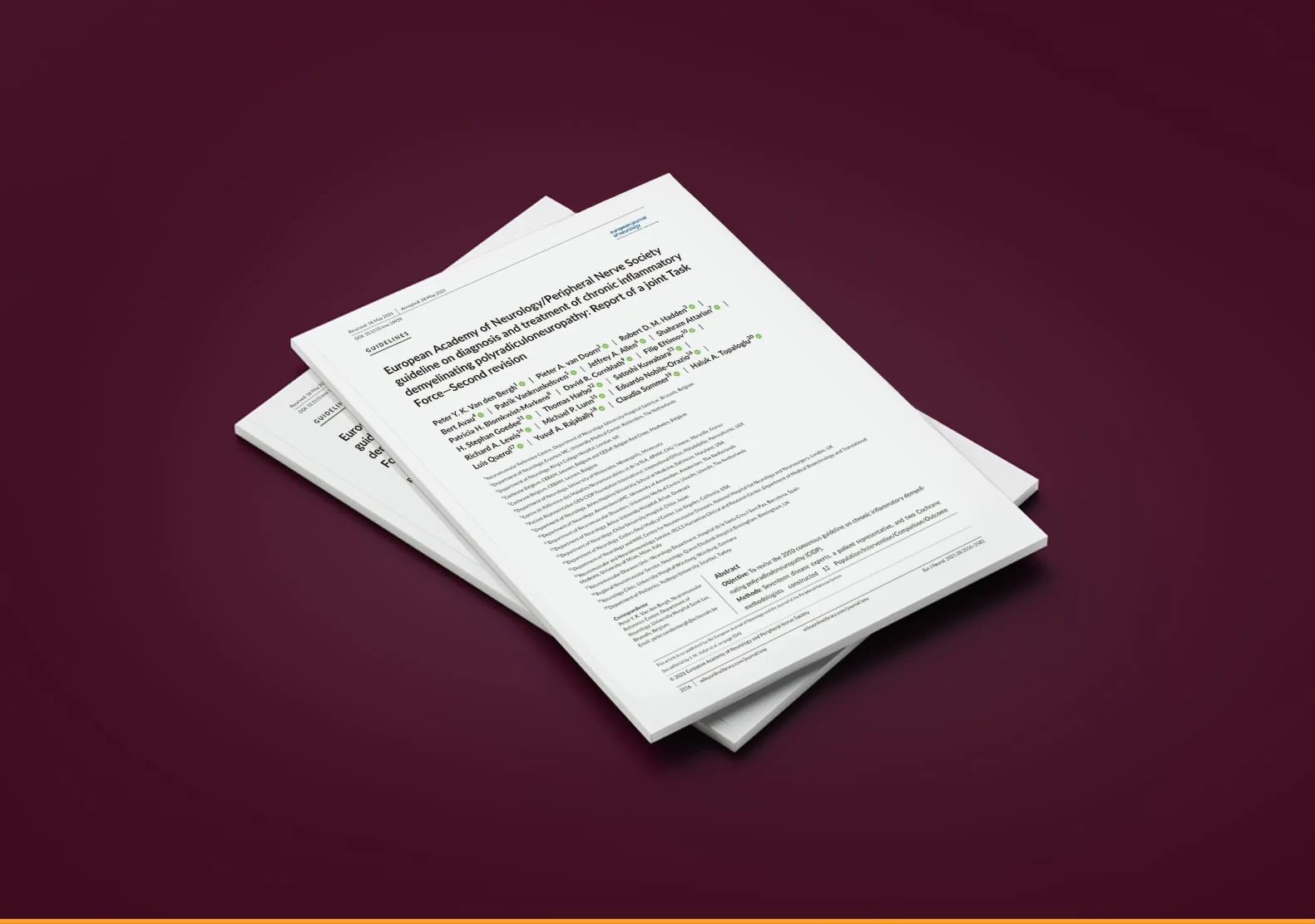
Abbreviations: CIDP, chronic inflammatory demyelinating polyneuropathy; EAN, European Academy of Neurology; IVIg, intravenous immunoglobulin; PNS, Peripheral Nerve Society; SCIg, subcutaneous immunoglobulin.
Reference: 1. Van den Bergh PYK, van Doorn PA, Hadden RDM, et al. Eur J Neurol. 2021;28(11):3556-3583. doi:10.1111/ene.14959
IMPORTANT SAFETY INFORMATION
WARNING: Thrombosis may occur with immune globulin products, including Hizentra. Risk factors may include: advanced age, prolonged immobilization, hypercoagulable conditions, history of venous or arterial thrombosis, use of estrogens, indwelling vascular catheters, hyperviscosity, and cardiovascular risk factors.
For patients at risk of thrombosis, administer Hizentra at the minimum dose and infusion rate practicable. Ensure adequate hydration in patients before administration. Monitor for signs and symptoms of thrombosis and assess blood viscosity in patients at risk for hyperviscosity.
Hizentra is contraindicated in patients with a history of anaphylactic or severe systemic reaction to human immune globulin (Ig) or components of Hizentra (eg, polysorbate 80), as well as in patients with immunoglobulin A deficiency with antibodies against IgA and a history of hypersensitivity. Because Hizentra contains L-proline as stabilizer, use in patients with hyperprolinemia is contraindicated.
IgA-deficient patients with anti-IgA antibodies are at greater risk of severe hypersensitivity and anaphylactic reactions. Thrombosis may occur following treatment with Ig products, including Hizentra.
Monitor patients for aseptic meningitis syndrome (AMS), which may occur following treatment with Ig products, including Hizentra. In patients at risk of acute renal failure, monitor renal function, including blood urea nitrogen, serum creatinine and urine output. In addition, monitor patients for clinical signs of hemolysis or pulmonary adverse reactions (eg, transfusion-related acute lung injury [TRALI]).
Hizentra is derived from human blood. The risk of transmission of infectious agents, including viruses and, theoretically, the Creutzfeldt-Jakob disease (CJD) agent and its variant (vCJD), cannot be completely eliminated.
The most common adverse reactions (observed in ≥5% of study subjects) were local infusion-site reactions, as well as headache, diarrhea, fatigue, back pain, nausea, extremity pain, cough, upper respiratory tract infection, rash, pruritus, vomiting, upper abdominal pain, migraine, arthralgia, pain, fall, and nasopharyngitis.
The passive transfer of antibodies can interfere with response to live virus vaccines and lead to misinterpretation of serologic test results.
Indications
Hizentra®, Immune Globulin Subcutaneous (Human), 20% Liquid, is indicated for:
- Treatment of primary immunodeficiency (PI) in adults and pediatric patients 2 years and older.
- Maintenance therapy in adults with chronic inflammatory demyelinating polyneuropathy (CIDP) to prevent relapse of neuromuscular disability and impairment.
- Limitation of Use: Maintenance therapy in CIDP has been systematically studied for 6 months and for a further 12 months in a follow-up study. Continued maintenance beyond these periods should be individualized based on patient response and need for continued therapy.
For subcutaneous infusion only.
Please see full Prescribing Information for Hizentra including boxed warning.
To report SUSPECTED ADVERSE REACTIONS, contact the CSL Behring Pharmacovigilance Department at 1-866-915-6958 or FDA at 1-800-FDA-1088 or www.fda.gov/medwatch.

Hizentra is manufactured by CSL Behring AG and distributed by CSL Behring LLC.
Hizentra® is a registered trademark of CSL Behring AG.
Hizentra Connect℠ is a service mark of CSL Behring LLC.